Digital Marketing
AI for digital marketing, organised by the job it does
Three guides, 626 pages and 340 numbered prompts. None of them is about a model. Each is about a job.
What each of these three books does
Pick by outcome, not by tool
The other half of the library teaches Claude, ChatGPT and Gemini. These three assume you can already get a usable answer out of one of them, and spend their pages on the work itself. All three are model-agnostic, so the question is not which AI you use — it is what you are trying to ship this week.
If the job is publishing
AI for Content Creators & Social Media is a production system, not a tour. Thirty-two chapters take one idea through hooks, short- and long-form scripts, captions per platform, thumbnails, and a repurposing engine that turns one asset into a month of posts. It ends where most books start: analytics, delegation and brand deals. The 100-prompt creator library is Appendix A.
If the job is running a business
AI for Freelancers & Small Business follows the money rather than the software. Thirty-five chapters on qualifying leads, discovery calls, proposals, holding your price, client email, onboarding, invoicing, chasing late payment and writing the SOPs that let you hire. It is the book for people who are the whole company.
If the job is spending a budget
AI for Google Ads is the most specialised book in the catalogue and the only one that assumes real expertise. Thirty-eight chapters on responsive search ads at scale, search-term mining, negative keyword architecture, account audits, and Google Ads Scripts written with AI — plus ten production scripts and a validation step at every point where a model would otherwise be trusted with arithmetic.
What all three share
One working pattern, rebuilt in each book's own vocabulary: write a reusable context file about your business once — the Brand Brief, the Business Brain, the Account Context Pack — then constrain the model hard, then verify what comes back rather than trusting it. Each book also ends with a numbered prompt library, so a prompt that worked in March is still findable in October: 100 for creators, B-001 to B-120 for freelancers, G-001 to G-120 for Google Ads.
All 3 guides
The Digital Marketing shelf
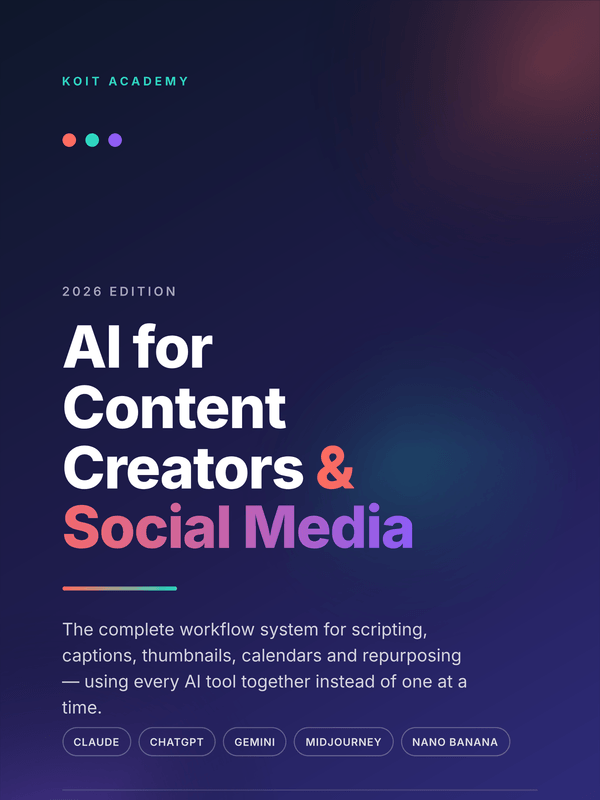
AI for Content Creators & Social Media 2026
32 chapters on AI-assisted content and social media, with a 100-prompt creator library and 7 appendices.
217 pages$19.99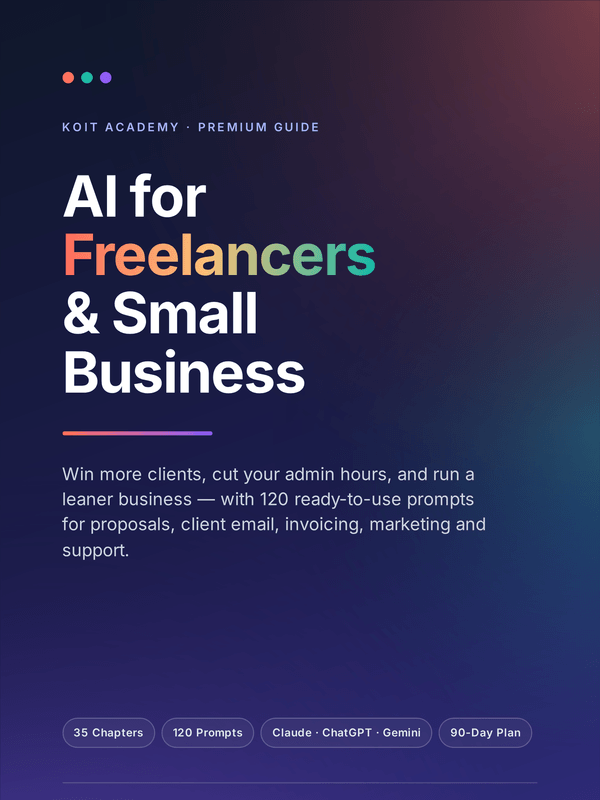
AI for Freelancers & Small Business 2026
35 chapters for freelancers and small businesses, with a 120-prompt business library (B-001 to B-120) and 7 appendices.
189 pages$19.99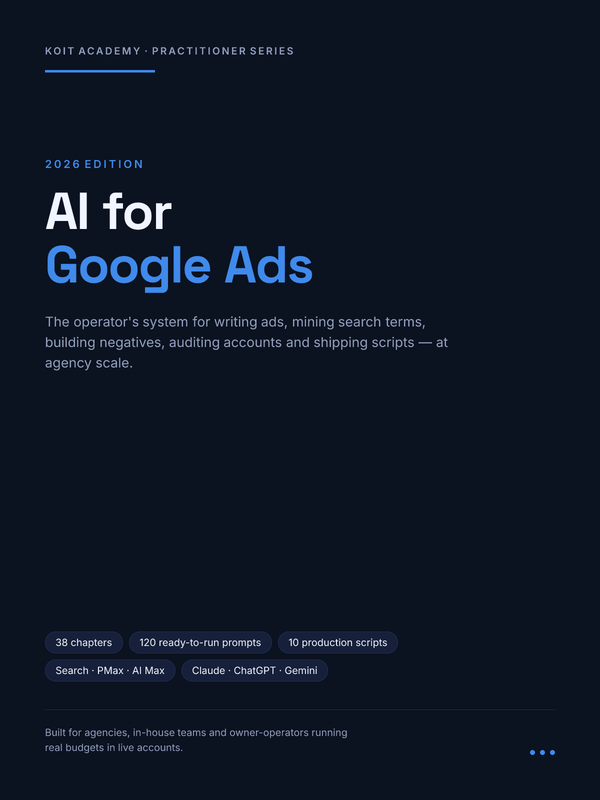
AI for Google Ads 2026
38 chapters on AI-assisted Google Ads, with a 120-prompt library (G-001 to G-120) and 10 production scripts.
220 pages$24.99
Side by side
Which job each book does
| Guide | Pages | Who it's for | What you'll be able to do |
|---|---|---|---|
| AI for Content Creators & Social Media 2026 | 217 | Creators and social teams shipping on a schedule | Run a repeatable week: ideas, scripts, captions, thumbnails, repurposing |
| AI for Freelancers & Small Business 2026 | 189 | Freelancers and owner-operators with no back office | Win work and run admin: proposals, pricing, client email, invoicing, SOPs |
| AI for Google Ads 2026 | 220 | Agencies, in-house teams and anyone spending real budget | Operate accounts at scale: ad copy, search terms, negatives, audits, scripts |
Choosing between them
Five questions worth answering first
Do I need the AI Tools guides before these?
Which one if I run a service business rather than make content?
Is the Google Ads book for beginners?
Do these three overlap?
Will these work if my team uses a different AI model?
Further reading
From the blog
Also in the library
Want the tools themselves rather than the jobs they do?
Seven guides on Claude, ChatGPT and Gemini, prompt engineering, image generation and a 200-template prompt library.