Digital Marketing · PDF · 220 pages
AI for Google Ads at a scale manual work cannot reach
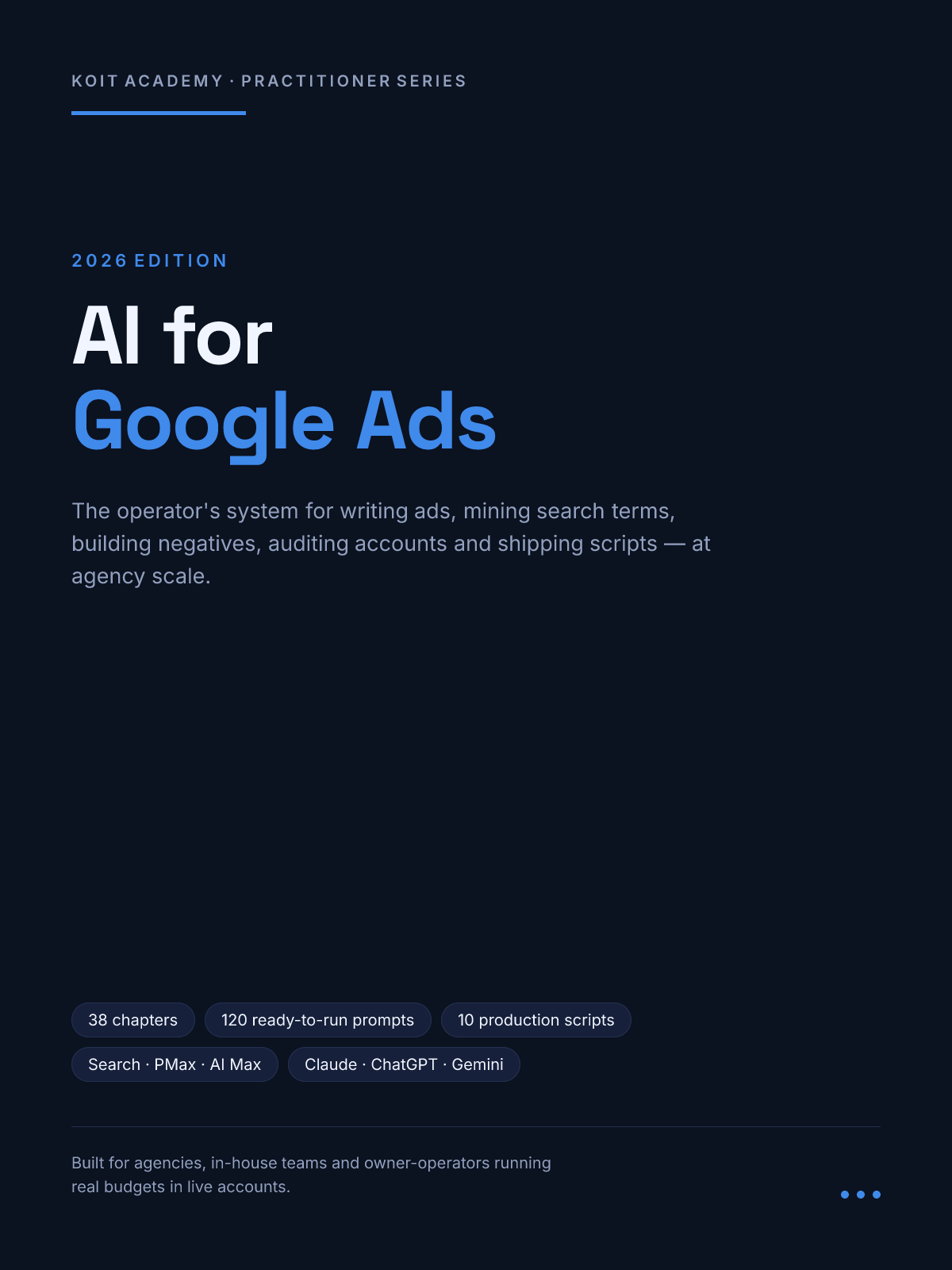
Thirty-eight chapters on the recurring work that decides account performance — search terms, negatives, ad copy at volume, audits and scripts.
- Classify four thousand search terms consistently in minutes, instead of accurately for three hundred and then rubber-stamping.
- Generate RSA variants that pass a mechanical character-count check before upload, not after 40% get rejected.
- Build negative keyword lists with an architecture, so a new negative never quietly kills your best-converting query.
- Write, review and deploy Google Ads Scripts through a protocol designed to fail safely on a live account.
VAT or sales tax added at checkout where it applies
Get instant access — $24.99Also in the Complete Library — all 10 for $79 (save $101.92).
- Instant download
- PDF, works on any device
- Pay by card or PayPal
- No subscription
Who this is for
Buy it if
- You run real budgets and have had to explain a cost-per-lead increase to someone who pays you.
- Search-term mining is the job you know matters most and skip most often because it is tedious.
- You manage more than one account and the reporting month is the part that hurts.
- You want the scripts as well as the prompts — ten production scripts, indexed in Appendix B.
Do not buy it if
- You have never run a Google Ads account. The book assumes you know what a search terms report is and does not stop to explain it.
- You want AI to run the account for you. Every workflow here has a human validation step, and the book argues that judgement about money is the thing not to automate.
- You are hoping for a way around Google policy. There is nothing like that here, and Chapter 10 is about staying inside the rules rather than outside them.
- You only spend a few hundred a month. The workflows are built for a scale where consistency beats attention, and below that scale attention still wins.
After reading it
What you will be able to do
- Say precisely what AI changes in a paid search account, and which of three automation layers you are actually building.
- Assemble an Account Context Pack that every later prompt reads, and keep it from going stale.
- Produce responsive search ads at volume with a validation layer that catches the character counts models get wrong.
- Run search terms through a classification pipeline, then mine the queries for what to build next.
- Design negative keyword lists as an architecture rather than an accumulating pile.
- Audit an account end to end, and design a structure that survives Google's own automation.
- Write GAQL and Google Ads Scripts with AI, deploy them through a safe protocol, and monitor them.
- Diagnose a performance change without guessing, and produce reporting a client will actually read.
What is inside
- Pages
- 220
- Chapters
- 38
- Parts
- 8
- Prompts
- 120
- Appendices
- 2
PART ONE · THE OPERATING MODEL5
- 1
What AI Actually Changes in a Google Ads Account
- 2
Three Layers: Assistant, Pipeline, Agent
- 3
Picking Your Model, and What Each Is Actually Good At
- 4
The Account Context Pack
- 5
Data Hygiene: What Goes In, What Never Does
PART TWO · AD COPY AT SCALE8
- 6
The 2026 Responsive Search Ad
- 7
Why AI Writes Bad Ad Copy, and the Six Fixes
- 8
The RSA Generation System
- 9
The Validation Layer
- 10
Pinning, Brand Safety and Compliance Copy
- 11
Variant Systems: Testing Copy Without Breaking the Account
- 12
Localisation and Multi-Market Copy
- 13
Performance Max Assets, Text Guidelines and AI Max
PART THREE · SEARCHTERM SAND NEGATIVEKEYWORDS6
- 14
The Search Terms Report Is the Most Valuable Asset in the Account
- 15
Building the Query Taxonomy
- 16
The Classification Pipeline
- 17
Negative Keywords: Extraction, Match Types and List Architecture
- 18
Mining Queries for What to Build Next
- 19
Query Data in PMax, Shopping and AI Max
PART FOUR · STRUCTURE, KEYWORDS AND THE AUDIT5
- 20
Keyword Research Without the Keyword Dump
- 21
The Account Audit Pipeline
- 22
Designing Account Structure That Survives Automation
- 23
Match Types, Bidding and Budget Logic
- 24
Landing Pages and Message Match
PART FIVE · SCRIPTS AND AUTOMATION6
- 25
Scripts: The Honest Primer
- 26
Writing Scripts With AI The Prompt System
- 27
GAQL and the Reporting Layer
- 28
The Safe Deployment Protocol
- 29
The Monitoring Library
- 30
Sheets, Apps Script and the Dashboard Layer
PART SIX · ANALYSIS AND DIAGNOSTICS5
- 31
Diagnosing Performance Changes
- 32
Reporting That Clients Actually Read
- 33
Competitor and Market Analysis
- 34
Lead Quality and Conversion Integrity
- 35
Forecasting and Budget Planning
PART SEVEN · RUNNING THE SYSTEM3
- 36
The Operating Cadence
- 37
Training a Team and Keeping Quality High
- 38
What to Automate Next, and What Never To
PART EIGHT · THE PROMPT LIBRARY2
- A
The 120Prompt Library
- B
The Script Library Index
Straight from the book
Two prompts, printed exactly as they appear inside
I am pitching a [VERTICAL] business in [MARKET]. Brief me on: how
customers in this vertical actually search, the buying cycle, typical
seasonality, the regulatory constraints on advertising, the claims that
are standard and the claims that are risky, and the three things a
paid search specialist usually gets wrong here. Flag anything you are
inferring rather than confident about.
The last sentence is the one that makes it safe to use. Without it you get a confident brief on an industry the model has half-guessed.
Write a handover document for this account. Cover: business model and
how a lead becomes revenue, account structure and the logic behind it,
deliberate decisions that look like mistakes and why they are not, live
tests, scheduled scripts and what they do, client communication
preferences, and known risks. Flag anything I have not given you that
the next manager will need.

CONTEXT PACK + DECISION LOG + STRUCTURE: [paste]
Written for the account you are handing over, and quietly the best audit of your own work — "decisions that look like mistakes and why they are not" is the line that finds the ones that actually were.
Sample pages
Three unedited pages from the book.
220
pages in total
38 chapters, all of it written like the three pages beside this one.
The prompt library
120 numbered prompts — G-001 to G-120
Format and delivery
- Format
- Pages
- 220
- File size
- 3.2 MB
- Text
- Searchable and selectable, not scanned images
- Reads on
- Phone, tablet, laptop, e-reader — anything that opens a PDF
- Printing
- Unrestricted
- DRM
- None. The file is not locked to a device or an account
- Delivery
- Download link immediately after payment
- Access
- Permanent — the file is yours once downloaded
- Edition
- 2026, written against the platform in Q3 2026
- Structure
- 38 chapters across 8 parts, then Appendix A (120 prompts) and Appendix B (10 scripts)
Why $24.99
Five dollars more than the rest of the catalogue, for the largest book in it and the only one that ships working code. Two hundred and twenty pages, 38 chapters, 120 numbered prompts and ten production scripts, aimed at someone who spends money in the platform every day. The comparison that makes sense is not against the other guides but against an hour of the work it replaces: a single search-term classification run over four thousand queries is an afternoon by hand, and the book turns it into a pipeline you run monthly. It promises no performance improvement, because no book can honestly promise one.
One payment, no subscription, and the file is yours to keep. The full delivery spec is above, and the refund policy says exactly when the money comes back.
Refunds
Refunds are handled by Payhip, where the payment is taken. Digital downloads are delivered instantly and cannot be returned, so completing checkout waives the statutory 14-day right of withdrawal. Refunds are still given for a file that will not open, a duplicate charge, the wrong product, or a product that materially differs from its description here — within 14 days, by email.
This wording matches the full refund policy exactly. If the two ever disagree, the policy page is the one that governs — and the difference is what causes chargebacks, so they are kept identical.
Before you buy
Questions about this book
Will any of this get my account suspended, or breach Google policy?
Why is this $24.99 when the other guides are $19.99?
Does it cover Performance Max and AI Max, or only search?
I do not write code. Can I use the scripts chapters?
Which model does it assume I am using?
How much of the book is prompts versus method?
Is there anything about attribution, GA4 or the measurement side?
How current is it, given how fast the platform moves?
Read next
 Digital Marketing
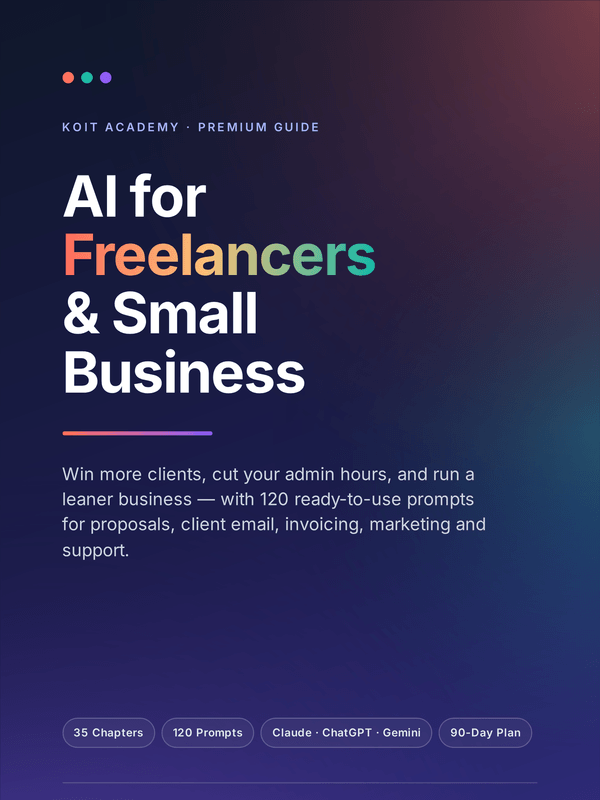
AI for Freelancers & Small Business 2026
35 chapters for freelancers and small businesses, with a 120-prompt business library (B-001 to B-120) and 7 appendices.
189 pages$19.99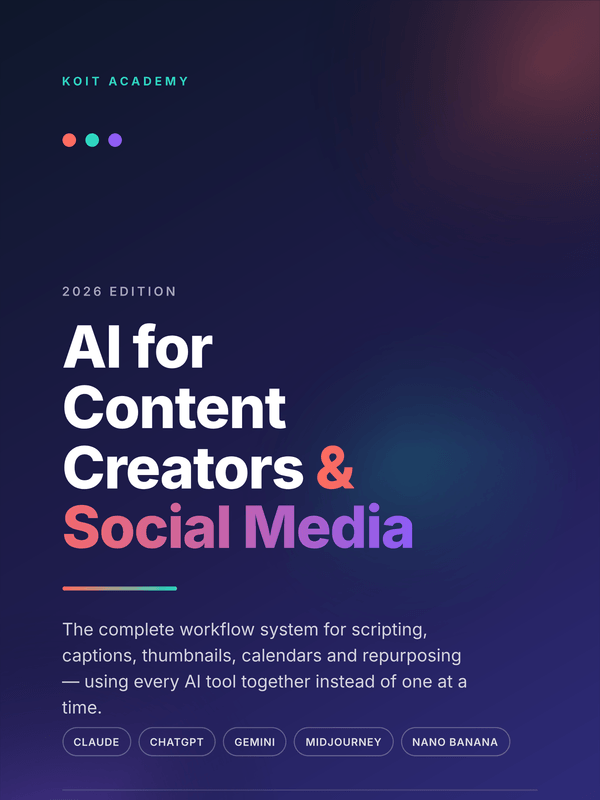 Digital Marketing
AI for Content Creators & Social Media 2026
32 chapters on AI-assisted content and social media, with a 100-prompt creator library and 7 appendices.
217 pages$19.99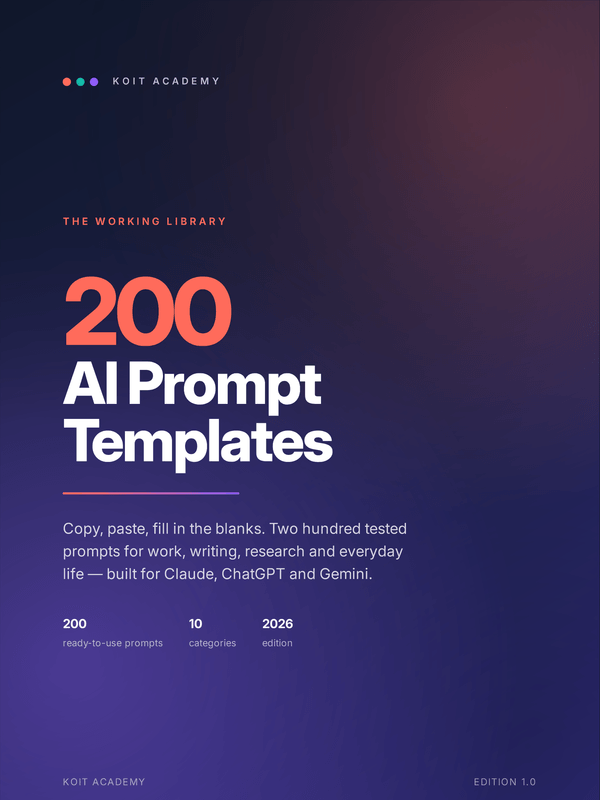 AI Tools
200 AI Prompt Templates
200 copy-and-paste prompt templates across 10 categories, numbered P-001 to P-200.
175 pages$7