AI Tools · PDF · 139 pages
An AI image generation guide for repeatable results, not lucky ones
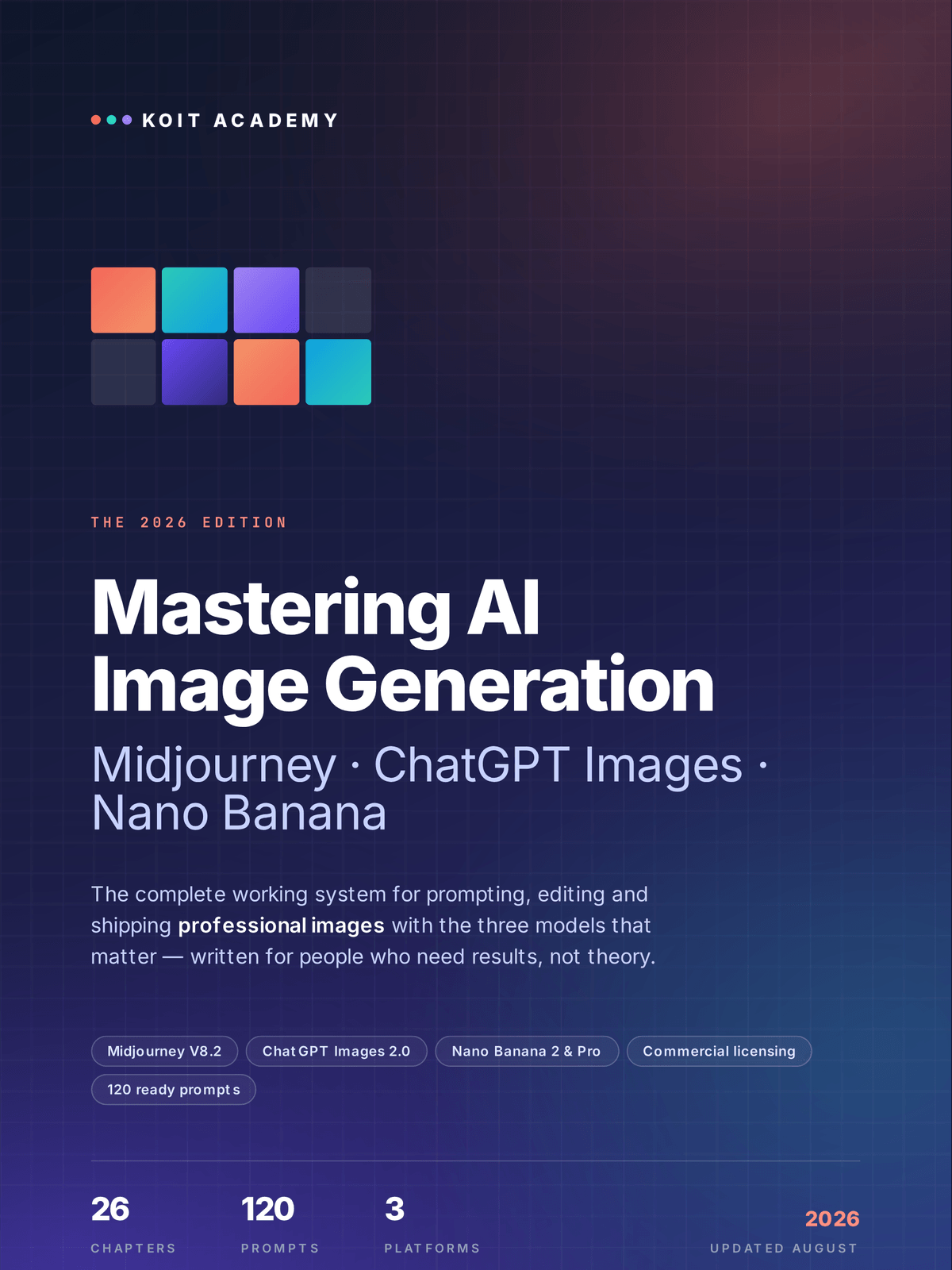
Twenty-six chapters on getting the same character, product and look every time, across Midjourney, ChatGPT Images 2.0 and Nano Banana.
- Get the same character, product or style across a whole campaign instead of a folder of near-misses.
- Write a prompt in seven defined slots, so when an image is wrong you know which slot to change.
- Read a failed generation against a table of thirty failure modes and apply the specific fix rather than regenerating and hoping.
- Know what you actually own, platform by platform, before you hand an image to a paying client.
VAT or sales tax added at checkout where it applies
Get instant access — $19.99Also in the Complete Library — all 10 for $79 (save $101.92).
- Instant download
- PDF, works on any device
- Pay by card or PayPal
- No subscription
Who this is for
Buy it if
- You generate images already and your hit rate is roughly one in ten. Chapter 21 is a diagnostic table for exactly that.
- You need repeatability — the same product, the same character, the same look, across a set.
- You are delivering images to clients or putting them on products, and the licensing question has started to worry you.
- You want all three current platforms in one book rather than three sets of scattered tutorials.
Do not buy it if
- You want one perfect image, once. The free tier of any of these tools plus persistence will get you there more cheaply.
- You are looking for design theory — composition, colour, typography as disciplines. This teaches you to drive the tools, not to art-direct.
- You only use one platform and never expect to change. Roughly half the book is platform-specific, so half of it will not apply.
- You want video generation. It is not covered at all.
After reading it
What you will be able to do
- Choose between Midjourney, ChatGPT Images 2.0 and Nano Banana for a given job, and say why.
- Explain how an image model reads a prompt, including why word order changes the result.
- Build prompts on the seven-slot formula so each element can be varied independently.
- Use Midjourney parameters, style references and personalisation profiles deliberately rather than by superstition.
- Hold consistency across a campaign — the same character, product and world in every frame.
- Speak the vocabulary that actually moves output: lens, light, film and frame for photography; medium, line, palette and era for illustration.
- Combine up to fourteen reference images, and produce infographics and 4K work where that is the right tool.
- Handle the commercial side: licensing, ownership, watermarking, disclosure, and the mistakes that end an account.
What is inside
- Pages
- 139
- Chapters
- 26
- Parts
- 7
- Prompts
- 120
- Appendices
- 5
PART I · FOUNDATIONS4
- 01
The 2026 Landscape — what changed, what died, what to use when
- 02
How Image Models Read Your Prompt — attention, weighting and why word order matters
- 03
The Seven-Slot Prompt Formula — the structure behind every good prompt
- 04
Set up — all three platforms running in twenty minutes
PART II · MIDJOURNEY5
- 05
Interface, Plans and GPU Hours — how not to burn your subscription in a week
- 06
The Parameter Reference — every flag that actually changes your output
- 07
Style Control — srefs, moodboards and personalization profiles
- 08
Consistency — the same character, product and world across a whole campaign
- 09
The Edit or — inpaint, outpaint, retexture, upscale
PART III · CHATGPT IMAGES2.04
- 10
What Changed — the reasoning image model and why it behaves differently
- 11
Conversational Edit ing — the iteration loop nobody else has
- 12
Text , Logos and Layout — winning the hardest category in image generation
- 13
Batches and Fidelity — eight coherent images from one prompt
PART IV · NANO BANANA4
- 14
Four Models, One Name Lite, 2, Pro, and which to open
- 15
Multi-Image Fusion — combining up to fourteen references
- 16
Infographics and 4K Work — the category Google quietly owns
- 17
Restoration and Retouching — real photo work, not just generation
PART V · CRAFT5
- 18
Speaking Photography — lens, light, film, frame
- 19
Speaking Illustration — medium, line, palette, era
- 20
Aspect Ratios and Platform Specs — the reference table you will use weekly
- 21
Diagnostics — thirty failure modes and the exact fix for each
- 22
Cross-Tool Workflows — generate here, edit there, finish somewhere else
PART VI · BUSINESS4
- 23
Licensing and Ownership — what you actually own, platform by platform
- 24
Watermarks, Disclosure and Hard Lines SynthID, C2PA and account-ending mistakes
- 25
Ten Ways People Make Money With This — with the workflow for each
- 26
Cost Control — a working studio for under fifty dollars a month
PART VII · THE PROMPT LIBRARY1
- —
120 ready-t o-use prompts across twelve production categories
APPENDICES5
- A
Midjourney parameter cheat sheet
- B
Aspect ratio and platform specification table
- C
Model selection decision tree
- D
Glossary
- E
What to re-check when a model updates
Straight from the book
Two prompts, printed exactly as they appear inside
[PRODUCT] centred against a dramatic [COLOUR] gradient background,
dramatic rim lighting outlining the product silhouette, subtle
floating position with a soft shadow beneath, high contrast,
premium and cinematic, generous space above and below the product
for text, shot straight on at 85mm, 1:1. Do not include any text.
Note how much of it is camera direction rather than description. The lens length and the instruction to leave space for text are what make the output usable in a layout.
[SCENE DESCRIPTION] composed vertically so all important visual
content sits within the middle 60% of the frame — the top 20% and
bottom 20% should be visually quiet and uncluttered to accommodate
interface overlays. [LIGHTING]. 35mm. 9:16 vertical.
Written around the interface rather than the image: the top and bottom fifths are kept deliberately empty because that is where the platform puts its own chrome.
Sample pages
Three unedited pages from the book.
139
pages in total
26 chapters, all of it written like the three pages beside this one.
The prompt library
120 numbered prompts
Format and delivery
- Format
- Pages
- 139
- File size
- 1.0 MB
- Text
- Searchable and selectable, not scanned images
- Reads on
- Phone, tablet, laptop, e-reader — anything that opens a PDF
- Printing
- Unrestricted
- DRM
- None. The file is not locked to a device or an account
- Delivery
- Download link immediately after payment
- Access
- Permanent — the file is yours once downloaded
- Edition
- 2026
- Structure
- 26 chapters across 7 parts, ending in a 120-prompt library, plus 5 appendices
Why $19.99
Image generation is the one place in this catalogue where the cost of not knowing is measured in credits. Every failed generation is money, and a one-in-ten hit rate is the normal starting point — the diagnostics table alone is aimed squarely at that ratio. Twenty dollars against a subscription you are already paying for, plus 26 chapters and a 120-prompt library, is priced on generations saved rather than skills promised. Nothing here suggests you will earn from the images; Chapter 25 describes how people do, and stops short of implying you will.
One payment, no subscription, and the file is yours to keep. The full delivery spec is above, and the refund policy says exactly when the money comes back.
Refunds
Refunds are handled by Payhip, where the payment is taken. Digital downloads are delivered instantly and cannot be returned, so completing checkout waives the statutory 14-day right of withdrawal. Refunds are still given for a file that will not open, a duplicate charge, the wrong product, or a product that materially differs from its description here — within 14 days, by email.
This wording matches the full refund policy exactly. If the two ever disagree, the policy page is the one that governs — and the difference is what causes chargebacks, so they are kept identical.
Before you buy
Questions about this book
I'm not a designer and have no visual eye. Is this book wasted on me?
Do I have to pay for all three platforms?
Can I sell what I generate, or use it for a client?
These tools change every few months. How does a book keep up?
What is the 120-prompt library organised by?
Does it cover the free tiers, or only paid?
How much of it is Midjourney?
Is this affiliated with Midjourney, OpenAI or Google?
Read next
 Digital Marketing
AI for Content Creators & Social Media 2026
32 chapters on AI-assisted content and social media, with a 100-prompt creator library and 7 appendices.
217 pages$19.99 AI Tools
Prompt Engineering Masterclass 2026
20 chapters on prompt construction, with 150 templates you can lift directly.
110 pages$19.99 Digital Marketing
AI for Google Ads 2026
38 chapters on AI-assisted Google Ads, with a 120-prompt library (G-001 to G-120) and 10 production scripts.
220 pages$24.99